October 10, 2008

The Pleasure of Slowness

Picture © Sarolta Gyoker, who posted it here.

This morning, I started reading Kundera's Slowness, a book I had kinda perused through some years back but not really read, and really enjoyed this wonderful paragraph:
"Why has the pleasure of slowness disappeared? Ah, where have they gone, the amblers of yesteryear? Where have they gone, those loafing heroes of folk song, those vagabonds who roam from one mill to another and bed down under the stars? Have they vanished along with footpaths, with grasslands and clearings, with nature? There is a Czech proverb that describes their easy indolence by a metaphor: 'they are gazing at God's windows.' A person gazing at God's windows is not bored; he is happy. In our world, indolence has turned into having nothing to do, which is a completely different thing: a person with nothing to do is frustrated, bored, is constantly searching for an activity he lacks."
"Gazing at God's Windows" would make for a a great blog's title. :)

October 9, 2008

The Strangler

John Ashberry, in an interview with Guernica magazine says:

Kenneth Koch’s poem "Fresh Air" is actually a kind of manifesto we all subscribed to. It talks about a Poetry Society where academic poetry is formulated that is disrupted by a kind of Batman-like figure called the Strangler, the enemy of bad poetry. I suggest you might take a look at it. One line in particular—someone gets up at the Poetry Society to read a poem that begins, "This Connecticut landscape would have pleased Vermeer," and the Strangler immediately strikes that line down.
I fear a lot of my poetry would have suffered a gruesome death at the hands of the The Strangler but given the amount of cr*p I see that gets published, especially online, as poetry, I wish there was a real Strangler to take care of bad poetry like this.

Also, at my cynical best, I too would agree with his opinion about political poetry preaching to the choir and not being too useful but like he says, poetry and words can goad you into awareness and other kinds of action...

My feeling is that most political poetry is preaching to the choir, and that the people who are going to make the political changes in our lives are not the people who read poetry, unfortunately. Poetry not specifically aimed at political revolution, though, is beneficial in moving people toward that kind of action, as well as other kinds of action. A good poem makes me want to be active on as many fronts as possible.
... in addition to the obvious beauty of words being a "renovating virtue."

French Writer Wins Nobel Prize

Never heard of him before today!

The Swedish Academy on Thursday awarded the 2008 Nobel Prize for literature to Jean-Marie Gustave Le Clézio, a French novelist, children’s author and essayist regarded by some French readers as one of the country’s greatest living writers.
Bookies be damned, it is a Frenchman that wins again. That makes it 14 French, all men, in 108 years of Nobel awards. ( Not sure if the 14 includes 2000 winner Gao Xingjian, who is a Chinese-born French writer*.) There are 10 Americans in that list, it seems and there apparently is a bias against American authors at the Nobel committee, with the Nobel judge and permanent secretary Horace Engdahl recently saying in an interview:
“The US is too isolated, too insular. They don’t translate enough and don’t really participate in the big dialogue of literature. That ignorance is restraining."
Oh well... my bet on John Updike or Phillip Roth winning one of these days is not going to happen, I guess! (Unless there is a wider backlash against Engdahl's words and so the Nobel committee hands one out next year to an American just to assuage things. Somehow, I doubt it. The Nobel committee cares too hoots about what the New Yorker or other Americans have to say about their choices...(and that's how it should be.)

Anyways, like Marco Roth writes in the Guardian: "The Nobel prize for literature doesn't really have much to do with literary excellence - and that's not a bad thing."... though calling it some irrelevant prize that clueless Swedes hand out does sound like a case of sour grapes and kinda undermines the fact that the Nobel, despite its roots in the literary hinterlands of Scandinavian backwaters, has become the most prestigious literary award.

We want the award to matter as though presented by angels rather than a few, imperfect Swedes with their own biases and tastes.
If we are shocked to discover that politics or some agenda external to mere aesthetics or "excellence", impinges on the judgment of literary work in an international context, we haven't been paying attention. The history of the prize is tied to Alfred Nobel's own broadly humanitarian aspirations to reward those who "have conferred the greatest benefit on mankind". Literature will always suffer from this kind of consequentialist standard, and the Swedes recognised this too.
--
* Coincidentally, I picked up Gao Xingjian's book of short stories: Buying a Fishing Rod for my Grandfather at the public library yesterday.

October 8, 2008

To dream is to create

Loved this....
We are all dreaming creatures who continually live in part in our dreams, dreams of what could be for ourselves and our children, even dreams of what is the case, dreams in which our husbands grow more charming, our wives more beautiful, our houses finer, our prospects richer than they are. Dreams in which our daily lives might be tolerable. To dream is to create.
According to a post at the New Yorker blog, Salman Rushdie said it in a lecture over the weekend on "the making of the Hamzanama, an illustrated manuscript created in the sixteenth Century under the Mughal emperor Akbar."

Apparently, Akbar commissioned fourteen hundred individual pieces of art (of which around 200 remain today) which narrate the " fantastical adventures and exploits of Amir Hamza, the uncle of the prophet Mohammed." Some of them were posted at the above New Yorker link and I am using one here (with full copyright to whoever owns them!) but there are a few more at that link that you can enjoy.

Rushdie7.jpg
The palace depicted illustrates “the birth of a dream architectural style that became a reality,” Rushdie said.

It seems there is a recent translation, The adventures of Amir Hamza - Lord of the Auspicious Planetary Conjunction by Ghalib Lakhnavi and Abdullah Bilgrami. (Translated by Musharraf Ali Farooqi.)

But before I ran into these links I had never heard of Amir Hamza and so I lead you to others who have done a great job of reviewing this book about a fascinating life. Read Jai Arjun's two wonderful posts at his blog and also William Dalrymple's review of the book in the NYT.

It seems the book is almost 950 pages and I doubt I will ever read it but I do want to some day soon read Dalrymple's recent book The Last Mughal: Fall of a Dyansty, Delhi, 1857.
It was received very well in India (and abroad too maybe) and considering I at least know something about the Mughals and the Mutiny of 1857, the detailed history of that period should make for very interesting reading. On the other hand, what I do not know about Amir Hamza could fill a book...a 950 page one! :)

October 6, 2008

Blood Oil

Curse of the Black Gold is a book of photo essays, with pictures by Ed Kashi and text by UC Berkeley professor Michael Watts, who has written extensively on the Economies of Violence: Petroleum, Politics and Community Conflict in the Niger Delta. (pdf)


The book takes a graphic look at the cost of oil exploration in the Niger Delta and traces the 50-year history of environmental degradation and community conflicts that have plagued the region. 

See a multi-media presentation about the book here. Also, NPR has featured the book in July; so has Slate.

Related:
- A related earlier post which mentioned the photo-essays book, What Really Matters, which includes pictures from Ed Kashi.
- Nigerian Oil - The Great Spoiler: A National Geographic video, where you can "hear how the people of the Niger Delta view their oil-rich, cash-poor region." You should also read the corresponding NG article, with pictures by Ed Kashi
- Vanity Fair article by Sebastian Junger about Blood Oil in the Niger Delta, including more pictures, these taken by Michael Kamber.


A young woman bathes in oil-slicked water in Rivers State.
Picture ©
Michael Kamber


A Matter of Perspective

I walked 5km at the Juvenile Diabetes walk here in Boston yesterday.

Good cause, lots of fun ...10,000+ enthused people, free food, good music... what's not to like.*

I came home to find that the local Fox News website had put up hundreds (almost 800!) pictures from the event. Thanks to digital cameras and cheap hard drive storage space, photographers at news outlets do not seem to need any kind of screening in their work any more! The pictures are taken with no restraint - replete with duplicates of same shots & some shaken pictures - and then downloaded and dumped online. Pictures seem to lose their value in this excess and overabundance.

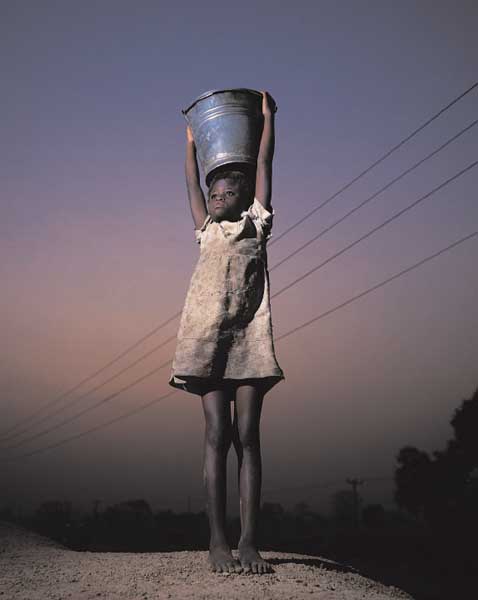
Then today, I see this one picture... and it is such a contrast. Not just from the hundreds of pictures at the Fox website but also to put into perspective the 5kms proudly walked by thousands, including me, yesterday.


A four-year-old girl in Ghana walks two-and-a-half miles (four kilometers) twice each day to fetch buckets of water for her family.
Picture © Brent Stirton


A four-year-old girl in Ghana walks two-and-a-half miles (four kilometers) twice each day to fetch buckets of water for her family.

The picture is featured in a book of photo essays, What Matters, which looks at 18 different environmental, economic and other issues that plague (no pun intended!) the world today. (I've also blogged about the book elsewhere.)

And so life goes on...

--
* Though, as much as I love Coke, I never could figure why such sugar-laden drinks were being distributed fore free at a juvenile diabetes walk. Not to pick on Coke, the from-concentrate fruit juices were no worse!

--
As men are not able to fight against death, misery, ignorance, they have taken it into their heads, in order to be happy, not to think of them at all. - Blaise Pascal.

It all adds up to happiness, doesn't it?

After my earlier post, I ran into Dirda's review of Julian Barnes' book in the WaPo, where I came upon this brilliant paragraph from the book - a beautiful exposition of our modern lives.
Bumper stickers and fridge magnets remind us that Life Is Not a Rehearsal. We encourage one another towards the secular modern heaven of self-fulfillment: the development of the personality, the relationships which help define us, the status-giving job, the material goods, the ownership of property, the foreign holidays, the acquisition of savings, the accumulation of sexual exploits, the visits to the gym, the consumption of culture. It all adds up to happiness, doesn't it -- doesn't it? This is our chosen myth, and almost as much of a delusion as the myth that insisted on fulfillment and rapture when the last trump sounded and the graves were flung open, when the healed and perfected souls joined in the community of saints and angels. But if life is viewed as a rehearsal, or a preparation, or an anteroom, or whichever metaphor we choose, but at any rate as something contingent, something dependent on a greater reality elsewhere, then it becomes at the same time less valuable and more serious. Those parts of the world where religion has drained away and there is a general acknowledgment that this short stretch of time is all we have, are not, on the whole, more serious places than those where heads are still jerked by the cathedral's bell or the minaret's muezzin. On the whole, they yield to a frenetic materialism; although the ingenious human animal is well capable of constructing civilizations where religion coexists with frenetic materialism (where the former might even be an emetic consequence of the latter): witness America."
And in this America, what do people like me do without religion or frenetic materialism to indulge us along the way? Life may be an "overrated way of passing the time" but we still need some fuel to take us through it.
Barnes notes with approval Somerset Maugham's view that "the best frame of mind in which to conduct life" is that of "humorous resignation." One of Barnes's friends shrewdly suggests that "our only defence against death -- or rather, against the danger of not being able to think about anything else -- lies in 'the acquisition of worthwhile short-term worries.' "
Aah...so the fuel I need is more short-term worries... but worthwhile ones! :)

Actually, the review ends with these lines - lessons we all could learn from in our march towards that day when the door finally shuts...

The philosopher Epicurus maintained that quiet routines like this offer our best response to death: Work hard at what you care about and enjoy moderate pleasures. It's really very good advice, but probably just a little too sensible for the unruly human heart.
In short, life is short. Enjoy ... in moderation! :)

Previous posts about happiness: 1, 2, 3, 4, 5, 6, 7, 8

Not one more refugee death, by Emmy Pérez

And just like that, my #NPM2018 celebrations end with  a poem  today by Emmy Pérez. Not one more refugee death by Emmy Pérez A r...